
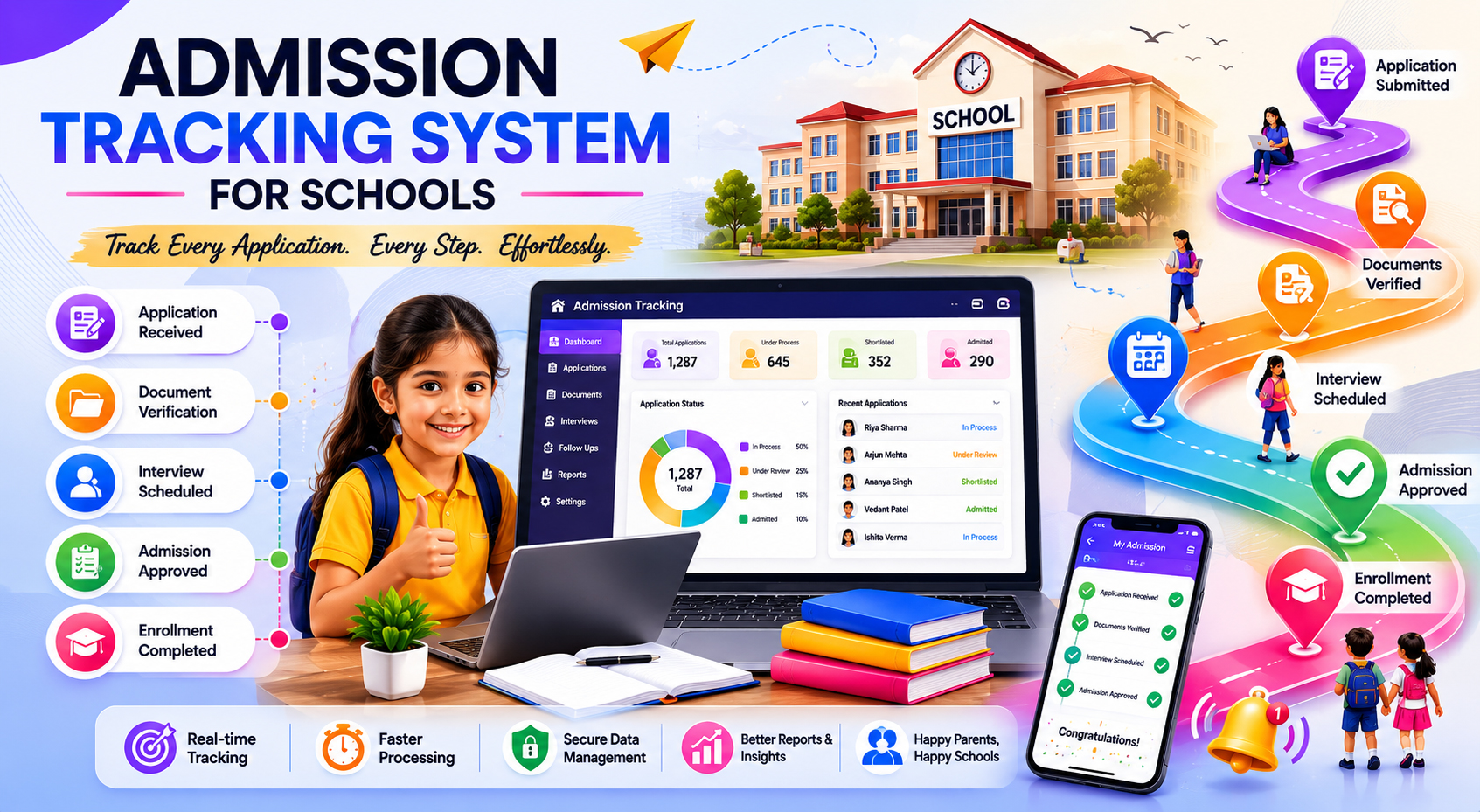
Admission Tracking System for Schools
Managing admissions effectively is a critical responsibility for every educational institution. As schools across India receive hundreds or even thousands of applications each academic year, keeping track of every admission inquiry, application form, document submission, verification stage, and enrollment status can become challenging. Traditional admission methods often rely on spreadsheets, paperwork, and manual follow-ups, making the process time-consuming and prone to errors. This is where an Admission Tracking System for Schools becomes an essential solution for modern educational institutions.
An Admission Tracking System for Schools is a digital platform designed to monitor and manage every stage of the student admission journey. From the moment a parent submits an inquiry until the student successfully completes enrollment, the system provides complete visibility into the admission process. Schools can track application progress in real time, manage documents efficiently, communicate with parents instantly, and ensure that no application is overlooked.
Why Schools Need an Admission Tracking System for Schools
Many schools still struggle with admission management because of fragmented processes. Admission teams often maintain records across multiple spreadsheets, email conversations, and physical files. As application numbers increase, it becomes difficult to monitor each applicant’s progress accurately.
An Admission Tracking System for Schools eliminates these challenges by providing a centralized platform where all admission-related information is stored securely. Administrators can instantly view application status, pending documents, verification updates, interview schedules, and enrollment decisions from a single dashboard.
This centralized approach improves efficiency and helps schools maintain a professional admission process that meets the expectations of modern parents.
Common Challenges Faced During Admissions
Educational institutions frequently encounter several admission-related challenges. One of the most common problems is tracking application status manually. Staff members may spend hours searching through files and spreadsheets to determine where an application stands in the admission cycle.
Document verification is another major challenge. Schools often receive multiple supporting documents including birth certificates, transfer certificates, identity proofs, photographs, and academic records. Managing and verifying these documents manually can delay admission decisions.
Communication gaps also create difficulties. Parents frequently contact schools to inquire about application status, interview schedules, document requirements, and admission decisions. Responding to these inquiries manually consumes valuable administrative time.
An Admission Tracking System for Schools addresses all these challenges by automating tracking, document management, and communication processes.
Key Features of an Admission Tracking System for Schools
Modern admission tracking solutions offer a wide range of features designed to improve enrollment management.
Application tracking allows administrators to monitor every admission application from submission to final enrollment. Schools can identify pending actions and ensure timely processing.
Document management features enable applicants to upload documents online while administrators can review and verify files digitally. This reduces paperwork and improves record organization.
Real-time status updates keep parents informed throughout the admission process. Automated notifications can be delivered through email, SMS, or mobile applications.
Workflow management tools help admission teams assign responsibilities, monitor tasks, and track progress across multiple applications simultaneously.
Online dashboards provide visual insights into admission performance, application volumes, conversion rates, and enrollment statistics.
Reporting and analytics features support data-driven decision-making by providing valuable admission trends and performance metrics.
Benefits for School Administrators
An Admission Tracking System for Schools significantly reduces administrative workload. Staff members no longer need to maintain multiple spreadsheets or manually update application records. The system automatically records every activity and maintains complete applicant histories.
Improved visibility enables administrators to identify bottlenecks and resolve issues quickly. Admission managers can monitor pending approvals, incomplete applications, and document verification requirements without searching through paper records.
Automation also reduces the risk of human error. Since information is captured digitally and stored centrally, schools experience fewer duplicate entries and data inconsistencies.
The result is a more organized and efficient admission department capable of handling higher application volumes with fewer resources.
Benefits for Parents and Students
Parents increasingly expect schools to provide digital services that simplify administrative processes. An Admission Tracking System for Schools improves the parent experience by offering transparency and convenience.
Parents can check application status online, upload required documents, receive instant notifications, and track admission progress without visiting the school repeatedly. This reduces uncertainty and builds confidence in the institution.
Students also benefit from faster admission processing and better communication throughout the enrollment journey.
Integration with School ERP Systems
One of the biggest advantages of a modern admission tracking platform is integration with School ERP software. Once admissions are confirmed, student information can automatically flow into attendance management, fee management, examination systems, communication modules, transport management, and academic administration.
This integration eliminates duplicate data entry and ensures consistency across all school operations. Administrators gain access to a unified student database that supports efficient management throughout the academic lifecycle.
Why Admission Tracking Matters for Indian Schools
The Indian education sector has become increasingly competitive. Schools must not only attract prospective students but also provide a smooth admission experience that reflects professionalism and efficiency.
An Admission Tracking System for Schools helps institutions improve operational efficiency while enhancing parent satisfaction. Schools can process applications faster, reduce paperwork, improve communication, and maintain accurate records.
As more schools adopt digital technologies, admission tracking systems are becoming an important component of educational administration. Institutions that embrace these solutions gain a competitive advantage while preparing for future growth.
Future of Admission Tracking Systems
Technology continues to transform school administration. Cloud-based platforms, artificial intelligence, mobile applications, and workflow automation are shaping the future of admission management.
Future admission tracking systems will provide predictive analytics, automated document verification, AI-powered communication assistants, and advanced reporting capabilities. These innovations will further improve efficiency and help schools make better enrollment decisions.
Schools that invest in modern admission tracking solutions today will be better positioned to meet evolving expectations and deliver exceptional admission experiences.
Conclusion
An Admission Tracking System for Schools is a powerful tool that helps educational institutions streamline admissions, improve communication, reduce paperwork, and enhance operational efficiency. By providing real-time visibility into every stage of the admission process, schools can manage applications more effectively while delivering a superior experience to parents and students. For Indian schools seeking to modernize administration and strengthen enrollment management, implementing an admission tracking system is a strategic step toward long-term success and digital transformation.

Leave a Reply